Categories
-

Week of July 14, 2024

Sunday

The term “noodles” is not quite the same as “pasta.” Noodles can be made from a variety of grains and are generally long and thin, but only pasta comes from durum wheat and can be many shapes.

Monday

Although you may only know a handful of pasta shapes, the dough which pasta comes from is so versatile that there are at least 600.

Tuesday

Noodle dishes have been traced back to ancient China, but these were rice or millet-based, and hence unlikely to be the predecessor of durum-based pasta known throughout the Mediterranean.

Wednesday

“Pasta” translates to “paste” or “dough,” which is what the individual shapes are cut from.

Thursday

Thomas Jefferson fell in love with pasta, all of which he called “macaroni,” during a trip to Naples, and thereafter imported much of it to the US for himself and friends. He did much to popularize it in the US, and the country’s first pasta factory later opened in his hometown of Philadelphia.

Friday

Italy is both the world’s largest pasta exporter and per capita consumer.

Saturday

Spaghetti was the topic of the most famous April Fool’s Day Joke in broadcast history. The 2.5-minute hoax BBC broadcast showed a Swiss family plucking spaghetti off the family “spaghetti tree” and reported that it was a good harvest after a mild winter and with the “spaghetti weevil” gone. An uncommon dish in England at the time, many viewers believed this was indeed how spaghetti was produced.

Categories
-

Week of July 7, 2024

Sunday

DEFCON = Defense readiness condition

Monday

SPAWAR = Space and Naval Warfare Systems Command

Tuesday

CONUS COLA = Cost of Living Adjustment in the Continental United States

Wednesday

DEERS = Defense Enrollment Eligibility Reporting System

Thursday

ARSOF = Army Special Operations Forces

Friday

HUDWAC = Head Up Display Weapon Aiming Computer

Saturday

Jeep, derived from “GP,” was a WWII-era abbreviation for a Ford-government contract vehicle (“G”) with a 80-inch wheelbase (“P”). The word jeep already existed in military parlance for an untested new vehicle or recruit, and later was applied to this vehicle.

Categories
-

Week of June 30, 2024

Categories
-

Week of June 23, 2024

Categories
-

Week of June 16, 2024

Facts By Any Other Name

Sunday

The rose is the national symbol of the United States, and six US presidents have at least one rose variety named after them (Washington, Lincoln, Kennedy, Hoover, Eisenhower, and Reagan). The first US president, George Washington, was also a rose breeder, and named a variety for his mother Mary.

Monday

The world’s oldest living rose bush is thought to have been planted in the year 800 AD, when the cathedral it climbs (Germany’s Hildesheim Cathedral) was built. Nearly obliterated by Allied bombs in WWII, it recovered and now the “Thousand Year Rose” can still be admired by visitors.

Tuesday

Rose aficionados and breeders recognize three broad categories of roses. Wild roses have fewer petals and are less fragrant. Old garden, AKA antique roses, are hardier and more fragrant, but only bloom once per season. Modern roses, those bred after 1867, have a larger and more continuous bloom, but tend to be less hardy and fragrant.

Wednesday

Roses have gone to war, symbolically. The English Civil War of 1455-1485 was called the “War of the Roses” because it was fought between the House of York, whose symbol was a white rose, and the House of Lancaster, whose symbol was a red rose.

Thursday

Though usually made of beads for durability, the rosary that devout Catholics pray on is named for a garland of roses, since the rose is a symbol of the Virgin Mary.

Friday

Both rose petals and rose hips, the fruit, can be eaten (ideally when grown without chemicals) and made into jams, jellies, and flavorings for many dishes.

Saturday

The late famed English rose breeder David Austin spent 15 years and about $3M developing the Juliet rose, but then sold if for $5M, making it the most expensive flower ever sold.

Categories
-

Week of June 9, 2024

Neato Namesakes, part 2

Sunday

Jules Leotard, French acrobatic performer and creator of the flying trapeze routine, also created the flexible, skintight one-piece garment that we call a leotard.

Monday

Working with physically challenged detainees at a WWI British internment camp, Joseph Pilates developed the low-impact techniques for strength and flexibility which bear his name.

Tuesday

James Brudenell, 7th Earl of Cardigan, was a flashy dresser before he led the Charge of the Light Brigade during the Crimean War in 1854. Despite his dubious command performance in that battle, the knitted waistcoats he wore became popular and are still known as cardigans.

Wednesday

Generations of indigenous Australians enjoyed the native macadamia nuts before they bore that name, but after a friend of chemist, doctor, and politician John Macadam had the nuts studied (and confirmed they didn’t poison a bold soul who first ate them), he named the food for his friend. Sadly, John Macadam died young at sea and never himself bit into one of the tasty morsels.

Thursday

In 1846, Belgian instrument designer Adolphe Sax was seeking a “robust lower voice” to join existing wind instruments, so he created and patented the saxophone.

Friday

After the Eiffel Tower was unveiled for the 1889 World’s Fair in Paris, George Ferris Jr. created the original enormous Ferris Wheel for the Columbian Exposition World’s Fair in Chicago to amaze crowds with a huge metal structure they could even ride on.

Saturday

Candido Jacuzzi, whose son Kenneth suffered from rheumatoid arthritis, developed a water pump to give him pain relief through hydrotherapy. Eventually he began developing and selling the larger units which now bear his name.

Categories
-

Week of June 2, 2024

The, Like, REALLY Big Cycles

Sunday

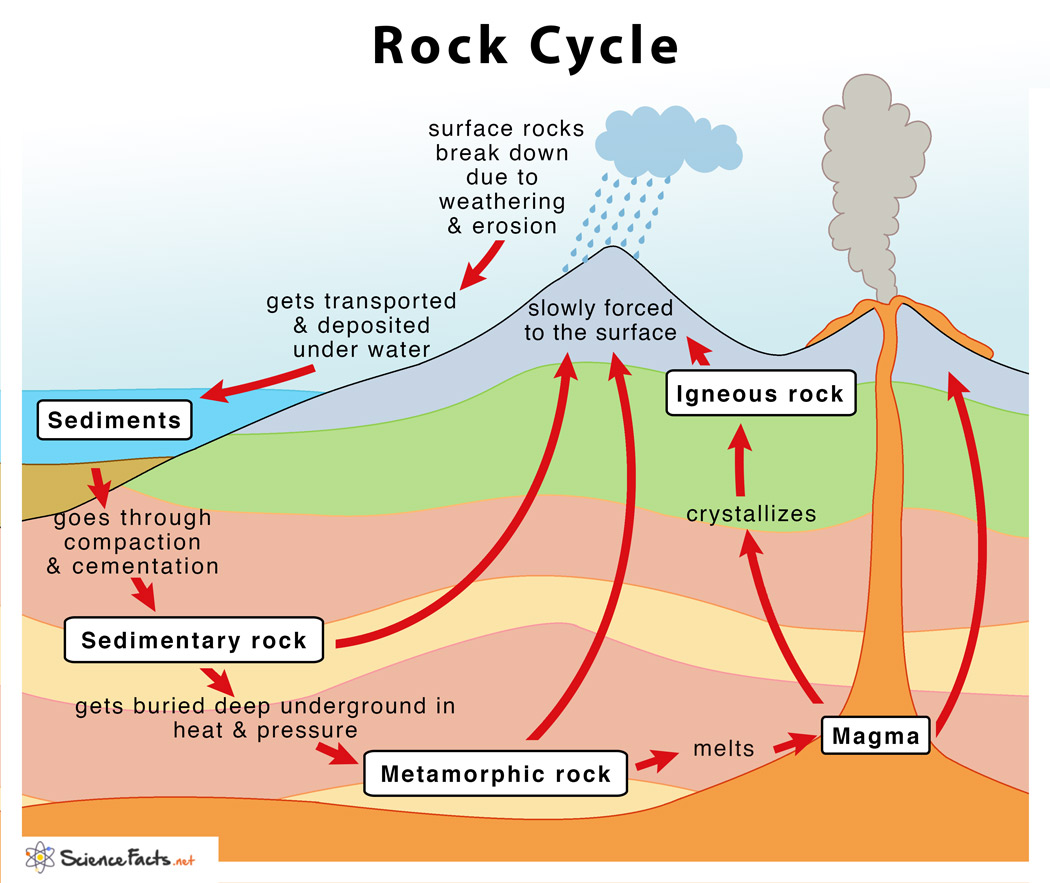
Rocks on Earth’s surface eventually erode into sediments, which often get transported to water bodies. At the bottom of these water bodies they get compacted and pushed deeper underground where they are buried with greater heat and pressure. The rock material then returns to the surface, either when melted into magma which flows from volcanoes as lava, or when the rocks it has joined return to the surface with tectonic activity. This is the rock cycle.

Monday

Liquid water from earth’s surface evaporates when heated by the sun, and condenses into clouds in the atmosphere. It then falls back down to earth as snow or rain, which evaporates directly or flows into other water bodies to evaporate and begin the cycle again. This is the water cycle.

Tuesday

Nitrogen gas, which comprises about 78% of Earth’s atmosphere, is “fixed,” or converted into a form usable to plants largely by bacteria and blue-green algae. When those plants die and decompose or are eaten by animals which later die, the remains are broken down by microorganisms into ammonia and ammonium. Nitrifying microorganisms then convert ammonia into nitrates, which can be converted into plant tissue or used by denitrifying bacteria, which produce atmospheric nitrogen gas. This is the nitrogen cycle.

Wednesday

Oxygen is used by humans and animals which breathe in oxygen and breathe out carbon dioxide (which is also produced by the burning of fossil fuels). Carbon dioxide is then taken in by green plants on land and algae and made into carbohydrates, the byproduct of which is oxygen. This is the oxygen cycle.

Thursday

The angle of Earth’s tilt relative to its plane of orbit around the sun is called obliquity, and varies between 22.1 degrees and 24.5 degrees, with the current tilt at 23.4 degrees. More glaciers are associated with smaller tilt angles and fewer glaciers with larger tilt angles. The period of these tilt cycles is about 41,000 years.

Friday

The shape of earth’s orbit around the sun changes from a near-perfect circle to a slight ellipse, a measurement known as eccentricity. This change comes from the gravitational pull of our massive planetary neighbors Saturn and Jupiter, and the cycle of most circular to most elliptical is about 100,000 years long.

Saturday

Gravitational pulls on the tides from the sun and moon cause the Earth to wobble slightly on its own axis, which affects the extremes of each season in the Northern and Southern Hemispheres. This wobble is called axial precession, and a cycle lasts 25,771.5 years.

These last 3 cycles are called Milankovitch Cycles, after Milutin Milankovitch, the Serbian scientist who proposed them.

Categories
-

Week of May 26, 2024

Digital Acronym Week (DAM!) #7

Sunday

BIOS = Basic Input Output Server

Monday

DNS = Domain Name Server

Tuesday

FTP = File Transfer Protocol

Wednesday

PPP = Point-to-Point Protocol

Thursday

VRML = Virtual Reality Markup Language

Friday

GCI = Common Gateway Interface

Saturday

MODEM = Modultator / Demodulator

Categories
-

Week of May 19, 2024

Immovable Facts

Sunday

Earth’s tallest mountain, Mt. Everest, doesn’t even make the top 10 among tall mountains in our solar system. That pack is led by Mars’ Olympus Mons, which is over 4 times higher than Everest and takes up an area about the size of Arizona.

Monday

On Earth, mountains can form in one of three ways: Volcanoes, fault-block mountains, in which one tectonic plate is pushed under another, or fold mountains, where two tectonic plates are pushed up as they collide.

Tuesday

As mountains go, the oldest are often relatively small after eons of natural erosion. The oldest known mountains on Earth, the Makhonjwa Mountains in South Africa, reach only 1,800 meters above sea level (compared to Everest’s 8,850), but are 3.6 billion years old.

Wednesday

Because so many mountains are in the ocean, measuring mountains requires a distinction of tallest vs. highest. Mt. Everest may reach closest to the sky, but it is not the tallest. Hawai’i’s Mauna Kea is nearly a kilometer taller when measured from its base, which is far under the Pacific Ocean.

Thursday

Because they can act as ramps for air masses, moisture, and snow, mountains can create their own weather. This is one reason you often see clouds at the tops of mountains, but nowhere else around.

Friday

Unsurprisingly, mountains play a big role in mythology and religion, and there are currently at least 66 “sacred” mountains in the world.

Saturday

The longest terrestrial mountain range on earth is the Andes Mountains, but under the sea lies most of the longest range on the planet. At over 40,000 miles long, the mid-ocean ridge runs around most of the globe.

Categories
-

Week of May 12, 2024

Flushed

Sunday

The “Cloaca Maxima” or “Greatest Sewer,” built in 6th century BC Rome to drain marsh and rainwater and later to channel waste, is still in use today.

Monday

Before modern sewer systems, many cities had toilets that simply emptied into cesspools, which themselves had to be emptied occasionally. In London, this job was legally required to be done at night by “night men” or “night soil men,” who then sold the waste to nearby farmers as fertilizer.

Tuesday

Human waste in the form of sewage is still used as crop fertilizer to this day, and works safely after toxins are removed.

Wednesday

Arguably the most ambitious project to accommodate sewage was the reversing the flow of the Chicago River, completed in 1900. Before that, the river flowed into Lake Michigan, contaminating the city’s drinking water with its own residents’ sewage and slaughterhouse waste. The reversal of the river’s flow sent these unpleasant ingredients downriver, away from the city.

Thursday

Storm drains and wastewater sewers are not the same, also known as “storm sewers” and “sanitary sewers.” One is intended for rain and melting snow that can be discharged into waterways untreated, the other for human waste that should be treated. Some cities combine these waste types into a “combined system.”

Friday

Many early efforts at urban sewer systems were abandoned during the Middle Ages, and some interesting etiquette began as a result. The gentlemanly rule that the man walk on the street side of a lady down the sidewalk comes from the fact that animal dung would collect near the street and people would empty dirty chamberpots into the street from windows above, offenses that a gentleman should endure rather than his female companion.

Saturday

Though wastewater treatment is more common than in times past, only about 48% is treated at all before being discharged into global waterways.